

What Changed In My Approach
Somewhere around my tenth year doing this, I stopped cutting perimeters the way I was trained to. Not all at once. It happened with one specific client who’d been coming to me for a while, mid-50s, hair that was dense and coarse and had started going gray at the temples in a way that was thickening things up instead of thinning them out the way gray usually does.
She wanted it shorter. She’d been wanting it shorter for a year and I’d been keeping it longer because I thought the length was softening things. That was wrong, and I think I knew it before I admitted it.
When I finally took it up past her jaw, took actual weight off the sides rather than stacking more at the perimeter to “frame the face,” her hair sat better in a week than it had in the three years prior. She’d rebooked every six weeks out of loyalty, not because she loved what I was doing. I didn’t love what I was doing either.
The thing I keep not saying clearly enough, even to clients who’d benefit from hearing it: removing weight at the perimeter on thick or coarse hair over 50 actually makes the hair behave better, not worse. Not always. But much more often than the standard approach of keeping bulk at the sides to soften the face.
That idea comes from somewhere real, from a time when haircuts had more structure and the weight could be controlled. But a lot of the clients I see now have hair that’s changed texture from hormonal shifts, have some gray mixed in that’s behaving differently from their original hair, and have a lifestyle where they’re not spending forty minutes with a round brush every morning.
Bulk at the perimeter on that hair type doesn’t soften anything. It puffs. It expands. It does the opposite of whatever the original theory was supposed to accomplish.
Texture After 50
There’s a thing that happens around this age that I don’t think gets enough attention, and I say that not because nobody talks about it but because the way it gets talked about usually skips the part that actually matters in terms of cutting decisions. Gray hair isn’t just a color. The strand itself is different.
It’s often coarser, sometimes wiry, sometimes more porous at the ends, and it doesn’t respond to product the same way. A client whose hair I’ve been cutting for years will suddenly have a texture I don’t recognize. Same person, same basic structure, but the hair is doing something new.
The density hasn’t changed but the behavior has. And if I’m still cutting it like it’s her hair from five years ago, it’s going to look like her hair from five years ago looked after she slept on it.
Short haircuts work on this hair type because shorter length means less weight pulling on strands that are now behaving differently. The length isn’t helping anything.
I’ve tried talking clients through this and sometimes I lose them because they’ve been told their whole lives that shorter hair is aging or that they should keep some length to look younger. I don’t agree with that as a blanket rule.
I’ve seen women in their late 50s with pixie cuts that look sharper and more modern than anything they were doing with a bob at shoulder length. Not because short hair is inherently better but because the specific hair was finally getting cut in a way that matched how it actually grows.
One Cut I Keep Recommending
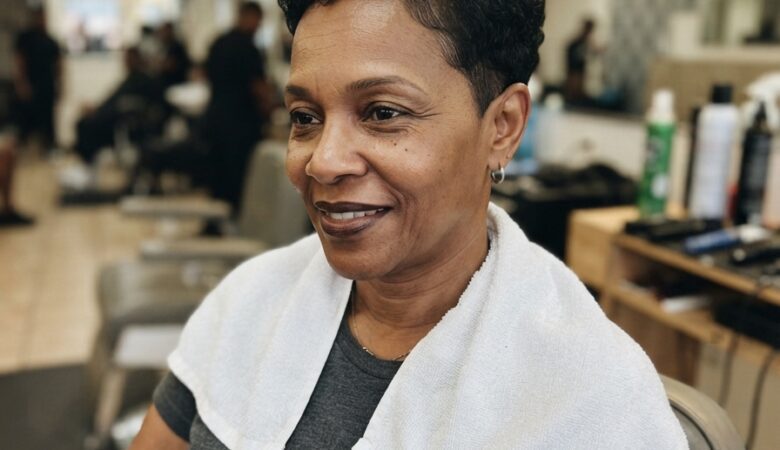
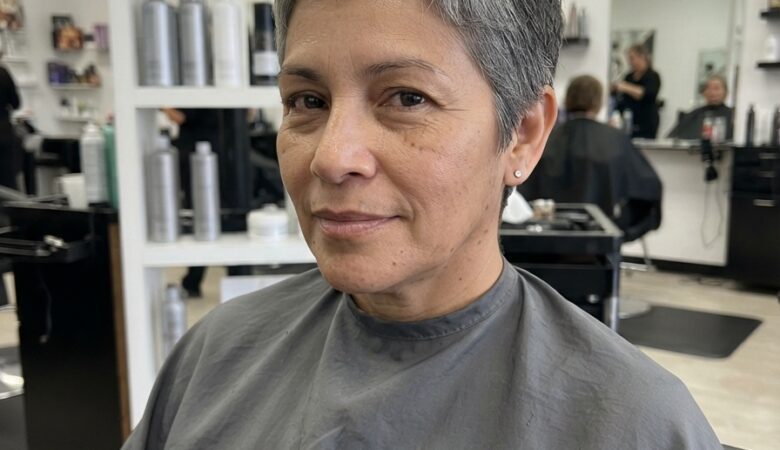
The cut I’ve been leaning on the most for this group of clients is something between a longer pixie and a cropped layer cut, where there’s length in the front, through the top, and the sides and back are taken up significantly. Not shaved, not a buzzed undercut situation. Just actually short.
An inch and a half to two inches at the back and sides, longer graduated layers coming toward the face. It leaves enough to style in the front while taking the bulk out of the areas where bulk causes problems.
I should say that I’m not recommending this because it flatters every face shape. That’s not how I think about it.
I recommend it because for hair that has thickened or changed texture and is resistant to lying flat or holding a style, this cut gives the product somewhere to work. If there’s too much hair, the styling product sits on top of the mass and can’t do anything.
Shorter underneath means the hair you’re actually working with is the top layer, which is usually where the texture is most manageable.
Whether keratin or bond-building treatments interact differently with post-menopausal hair texture in a way that would change how long cuts actually hold on this hair type, I honestly don’t know. It came up with a client last spring and I didn’t have a clean answer. Anyway.
What I Skip At Consultation
A lot of consultations for short cuts with clients over 50 spend too much time on maintenance conversations. How often will they need to come back in, how do they style it at home, what products should they use.
I do talk about those things but I’ve started pushing them toward the end rather than leading with them because when maintenance is the frame for the whole conversation, clients make decisions based on manageability rather than what will actually look good on them. Those aren’t the same thing. A cut can be easy to maintain and still look like an afterthought.
What I try to get at early is what they don’t want. It’s more specific information. What they don’t want is usually precise. What they want is usually vague.
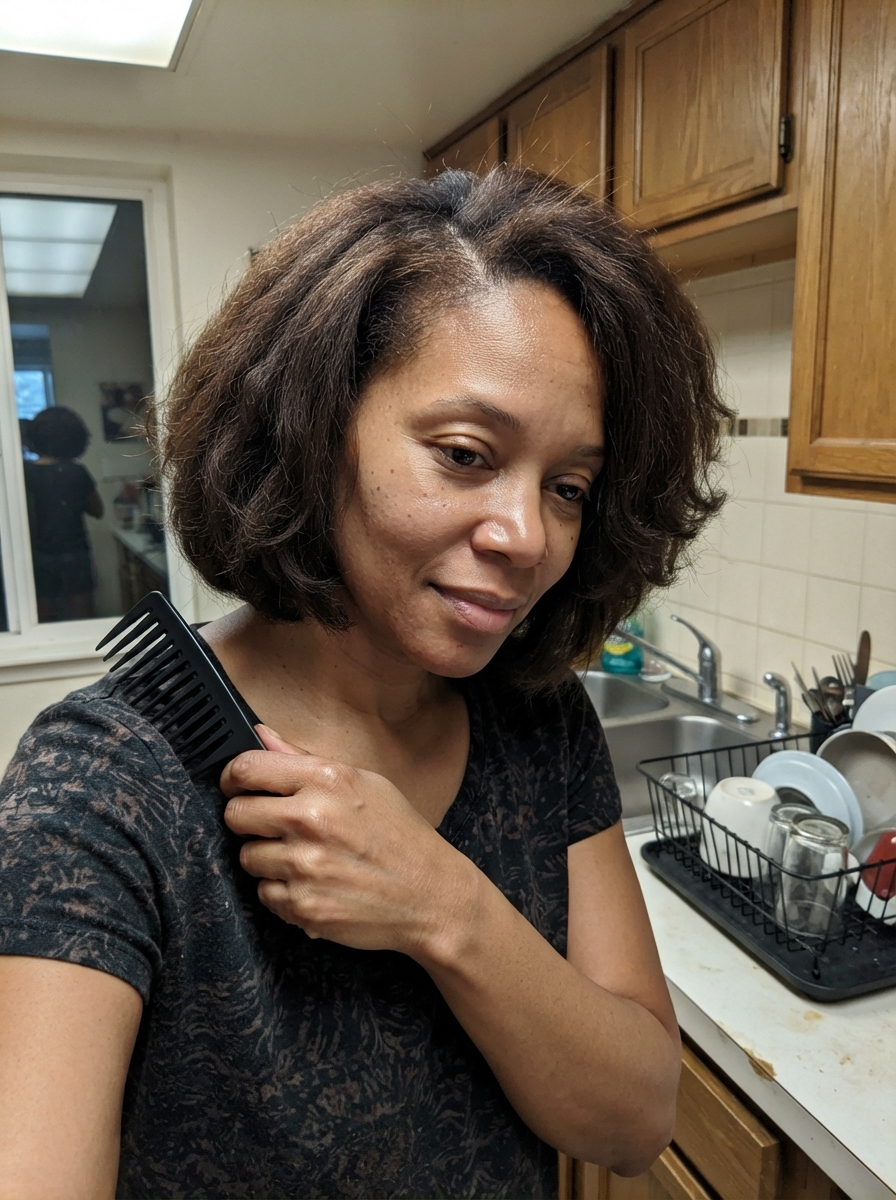
If someone tells me they don’t want helmet hair, they don’t want anything that needs to be set and sprayed, they don’t want to look like their mother, that’s three usable constraints I can actually build a cut around.
“Something low maintenance and modern” is not a constraint. It’s a general direction that could mean fifty different things.
How Weight Distribution Actually Works On Fine Hair
Fine hair over 50 is a different problem entirely and I want to be clear that most of what I said in the first section doesn’t apply here. The client with thick, coarse, graying hair needs weight removed.
The client with fine hair that’s thinned further over the years needs almost the opposite approach, and conflating those two situations is where a lot of bad short haircuts come from. I’ve done it.
Early in my career I had a default short cut that I was applying to both hair types with modifications that weren’t significant enough, and the results were inconsistent in ways I couldn’t fully account for at the time.
Fine hair over 50 that’s also lost some density needs length to look like it has any substance at all. That sounds counterintuitive because the hair is already thin and you’d think less length means less weight dragging it flat, but what actually happens when you cut fine thin hair too short is that you can see through it.
You can see the scalp. The hair that’s left doesn’t have enough of itself to cover anything.
A longer pixie on truly fine hair sits flatter and looks more intentional than a cropped cut that exposes the scalp at the crown. I’ve found that keeping the top layers at three to four inches and being more conservative about how much I take off anywhere the hair needs to cover something gives a better result than going short all over and hoping the styling fills it in. It doesn’t fill in.
The one product category that actually changes things for fine hair in short cuts is something lightweight that adds grip without adding weight. Not a volumizing mousse, which usually does nothing and sometimes makes things worse by coating the strands and making them clump.
Something that gives a slight texture hold so the hair can actually be placed. I’ve been rotating through a few different options with clients over the past couple of years and haven’t landed anywhere fully consistent, but the ones that seem to perform best are the ones with light hold and no shine.
Shine on fine short hair over 50 reads as flat. It reads as pressed down. Matte finish gives the hair more apparent thickness because it catches light differently across the strands.
Face Shape Advice I’ve Stopped Giving
There’s a version of this article that would have a section about which short cut works best for which face shape. Oval faces can do anything, round faces should avoid width at the sides, long faces need volume at the jaw, and so on.
I gave that advice for years. I learned it early and repeated it because it seemed useful and clients seemed to want it. I’m not sure it’s wrong exactly, but I’ve stopped leaning on it as much because what I’ve actually seen in my chair doesn’t map onto it cleanly.
A client I had for maybe two years before she moved had a round face, by any standard measurement. Shorter on top would be the textbook recommendation.
She had a cut with significant volume at the sides and shorter through the crown, which is exactly what you’re not supposed to do on that face shape, and it looked good on her. It looked good because her bone structure below the cheekbones was narrow in a way that the face shape category didn’t capture, and the width at the sides actually balanced the lower half of her face rather than widening it.
The appointment where we landed on this had run over because her previous cut hadn’t worked and she was frustrated, so we tried something neither of us had planned on that day. It worked because of a specific structural detail, not because we followed the rules or successfully broke them.
There wasn’t a lesson. It just worked.
Face shape guidelines give clients something to hold onto when they’re scared of going short. That’s their real function.
When someone’s considering taking off four inches or more, telling them that their face shape is good for a certain kind of cut gives them a framework. I understand why the framework exists. I just don’t use it as the primary driver of technical decisions anymore.
Gray And The Cutting Decisions That Follow From It
Gray hair at different stages of the transition changes what a short cut can do, and this is something I think about now more than I used to. A client who’s fully gray, several years past any color, has hair that’s stabilized into whatever texture it’s going to be. I know what I’m working with.
A client who’s mid-transition, with some original color still coming in at the back or still holding at the ends from previous color, has two different textures in the same haircut. The gray portion is behaving one way. The remaining pigmented hair is behaving another way.
Short cuts make this visible in ways that longer cuts can hide, because at shorter lengths the different textures sit right next to each other without enough length to blend them out.
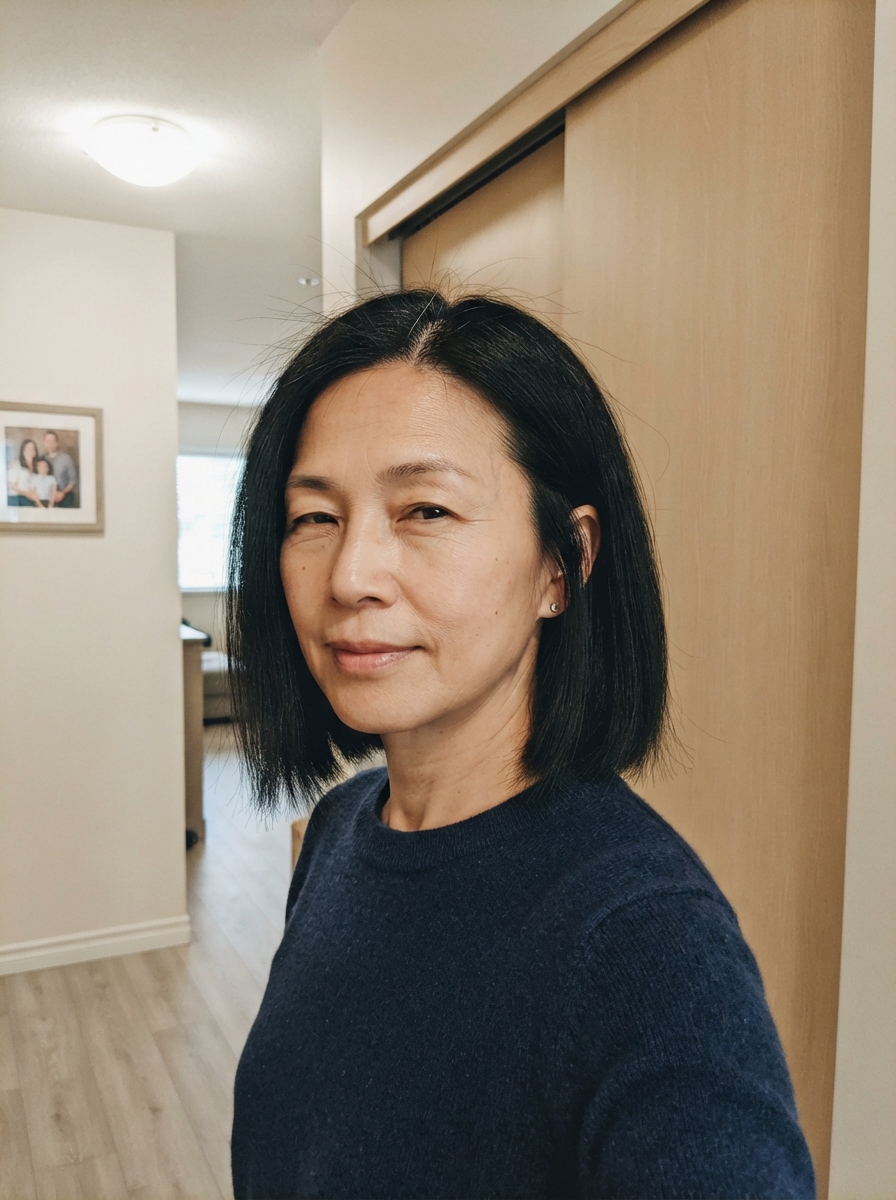
I don’t think mid-transition is a reason to avoid short hair. But it does change the technical approach.
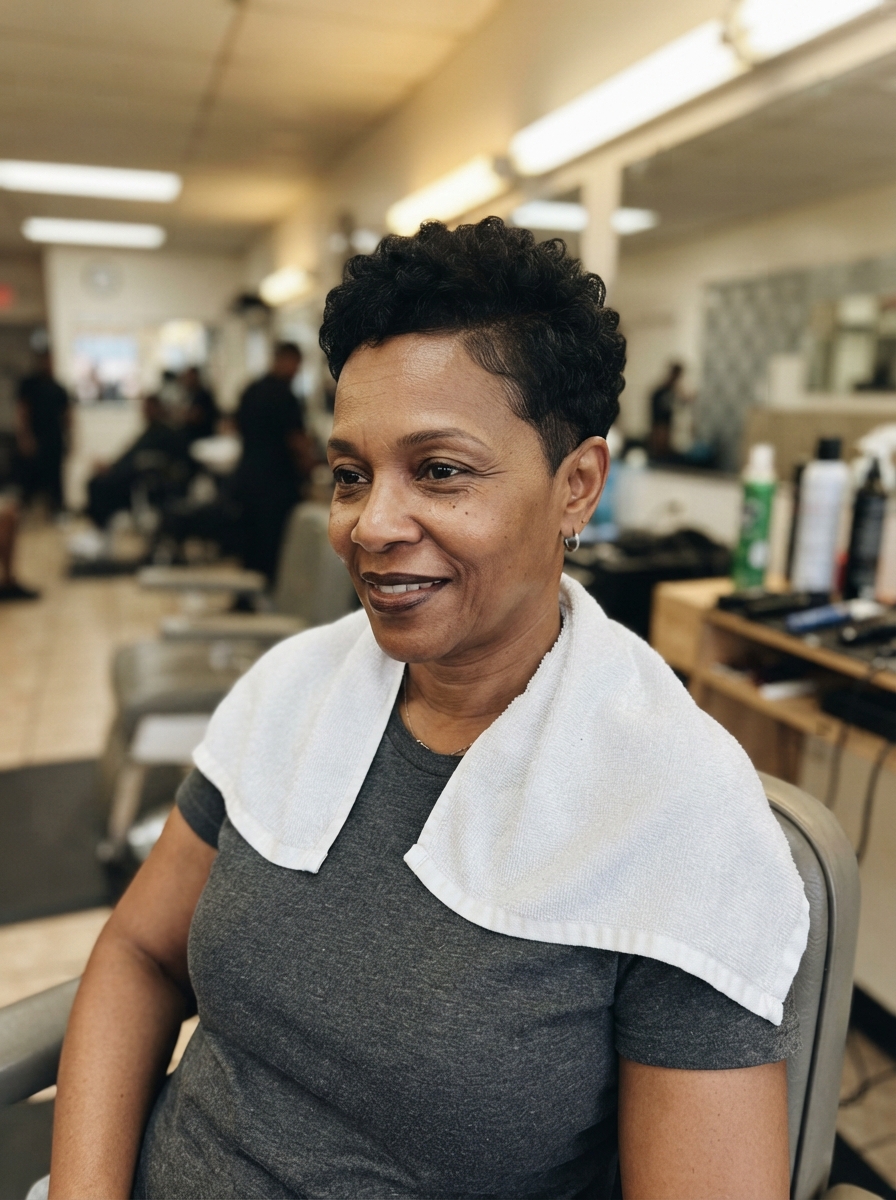
The areas where the hair has fully transitioned to gray are usually coarser and might actually need more length to stay calm. The areas where there’s still pigmented hair might be fine shorter.
So the graduation in the cut has to account for that, which means I’m sometimes making cutting decisions based on texture zones rather than following a standard graduation pattern. It takes longer at the consultation to figure out where those zones are.
Clients don’t always know what I’m looking at when I’m sectioning through the hair and feeling the texture change. Some find it reassuring that I’m paying that level of attention. Some just want to know if it’s going to look good.
When The Client Has Already Cut It Somewhere Else
This is a situation I run into more than I’d expect. Someone books with me specifically for a short cut, and when they come in they’ve already had it cut somewhere else recently, usually because they got impatient or found a cheaper option.
The cut isn’t what they wanted. They’re here to fix it. This is not the appointment I was planning and it changes almost everything about how I approach the session.
The problem isn’t that the previous cut was badly done, necessarily. Sometimes it was. More often it was just cut for someone else’s hair.
The shape is wrong for this person’s specific texture and growth pattern. And because hair at short lengths doesn’t give you much to work with in terms of correction, fixing a short haircut usually means going shorter in places that weren’t supposed to be shorter, or leaving things longer than I’d otherwise choose in order to let the shape grow into something workable.
I can’t always give the client what they came in for because the hair won’t allow it yet. That conversation goes better when I show them what I mean physically, putting their hair where I want it to be and showing them why it doesn’t sit there yet, rather than explaining it abstractly.
Most clients can see it once it’s demonstrated. That doesn’t make the appointment easier but it makes the outcome less likely to be a second disappointment in a row.
Grow-Out and What Nobody Plans For
Most clients who book a short cut are thinking about the cut. Almost none of them are thinking about eight weeks after the cut, when the shape has grown out enough to look unintentional but hasn’t grown out enough to do anything different with.
That gap is where I lose clients. Not to other stylists necessarily, though that happens too. I lose them to avoidance.
They stop booking because the hair is in an awkward phase and they don’t want to deal with it, and then they come back four months later with something I have to start over on.
Short haircuts over 50 have a specific grow-out pattern that I try to talk about before we start rather than after. The top usually grows faster than the sides.
On a cropped cut, that means the top starts to look heavy and the sides start to look sparse before anything looks intentionally longer. It’s the least flattering possible combination.
If I know a client is trying to grow out from a short cut, I change the maintenance schedule, not the cut itself. More frequent trims on the sides and back to keep them in proportion while the top catches up.
Not everyone wants to come in more often. Some clients would rather let it go and deal with the awkward phase.
That’s a real choice and I don’t push back on it, but I want the decision made consciously before the appointment rather than by default six weeks later.
There’s also the question of what short hair over 50 looks like when it needs a cut badly, which is different from what longer hair looks like when it needs a cut. Longer hair gets heavy and loses movement.
Short hair that’s overdue loses its shape entirely and starts to look like an accident. The window between “this cut looks good” and “this cut looks like it used to be a cut” is narrower with short hair.
I tell clients this because the expectation gap around maintenance is one of the main reasons people go back to longer hair after trying short. They weren’t expecting to come in as often.
Styling at Home on Short Hair
The styling conversation is where I probably spend the least amount of time that I should. Not because it’s unimportant but because by the time we get to it at the end of an appointment, the client is ready to leave and I’m ready to move on.
I’ve started writing things down for clients who I know aren’t going to retain a verbal explanation, not because I think they’ll reference it later but because the act of writing it down while they’re watching seems to make it stick better than just talking.
Short hair styled wrong looks worse than short hair unstyled. That’s the thing I want clients to understand before they leave.
With longer hair, doing nothing is usually fine. The weight holds it down, it falls into something presentable.
Short hair that’s been slept on and not touched reads as disheveled in a way that longer hair in the same condition doesn’t. The solution isn’t complicated.
Water and a small amount of product in the morning, reshaped with fingers, dried for a couple minutes if needed. That’s most of it.
But clients who’ve had longer hair for decades don’t have that habit and it takes a few weeks to build it. The first two weeks after a short cut are usually the hardest because the hair is new and the routine isn’t set yet.
I’ve had clients come back at their six-week rebook and say the cut isn’t working, and when I ask them to walk me through what they’re doing at home it turns out they’re not doing anything.
They wash it and let it dry and then look at it and feel disappointed. The cut is fine. The hair just needs five minutes in the morning that it wasn’t getting.
What I Actually Think About Pixies
The pixie gets talked about as a bold choice, a statement cut, something you have to commit to. I find that framing annoying.
It’s a haircut. It’s shorter than other haircuts.
The boldness framing makes clients feel like they’re making a personality declaration when they’re actually just deciding how much hair they want. I’ve seen clients talk themselves out of cuts that would have genuinely suited them because the cultural weight around “the pixie” made the decision feel bigger than it was.
For clients over 50 specifically, the pixie, or the range of cuts that get called pixies, often works better than it did on those same clients in their 30s. The face has more structure. The features read more strongly without hair framing them.
Some clients are surprised by this. They’ve been told their whole lives that hair frames the face and therefore more hair is more framing and more framing is better. That’s not how faces work.
A strong jawline or prominent cheekbones actually read better without hair competing with them. Not always. I’m not making a universal claim.
But I’ve cut hair short on clients in their mid-50s who looked genuinely better than they had in the decade I’d known them, and the change wasn’t because short hair is objectively better. It’s because their face had become the right face for that cut.
I’ve also cut hair short on clients where it didn’t work, where the features that were supposed to come forward receded instead, or where the neck or the ears were something the client hadn’t thought about and then couldn’t stop thinking about. That happens.
Short hair doesn’t hide anything in the way longer hair can. If a client has never considered what their ears look like without hair covering them, a pixie will make them consider it.
Some clients are fine with it. Some aren’t. I try to have that conversation gently before the cut rather than after.
This doesn’t change my overall position. Short hair on women over 50 is undercut by hesitation more often than it’s undercut by being a bad fit for the face.
Most of the clients I’ve seen who tried it and decided it wasn’t for them made that decision in the first two weeks, before the cut had settled, before they’d figured out how to style it, before the shape was fully grown in from the initial cut.
Two weeks is not enough time. Six weeks is closer to a real assessment of whether a short cut is working.
The ones who stick with it past that first difficult month almost universally end up preferring it to what they had before. Not because I talked them into it. Because the hair, once they know how to deal with it, actually does what they wanted it to do.


Leave a Reply